What Is Endodontic Treatment and Why Does a Microscope Help
Root canal treatment is one of the most technically demanding procedures in restorative dentistry. Canals can be curved, extremely narrow or branched in ways impossible to see with the naked eye. A dental microscope magnifies the working field 8–25 times: the clinician can spot every micro-branch, micro-crack and fragment of necrotic tissue. That is why microscope-guided root canal treatment produces significantly fewer complications and re-infections.
How the Procedure Works at iDent
We start with a targeted X-ray or a full 3D scan on our PaX-i3D Smart tomograph, depending on case complexity. After anaesthesia, a rubber dam is placed to keep saliva out of the canal. Under the microscope I clean and shape the canals mechanically and chemically, then seal them hermetically. The session finishes with restoration of the crown portion of the tooth.
- Endo package, 1 canal with microscope — UAH 4,900.
- Endo package, 2 canals with microscope — UAH 8,800.
- Canal retreatment with microscope — from UAH 2,750.
- Initial consultation — free when treatment is planned.
Is Root Canal Treatment Painful
Modern anaesthesia reliably numbs even the most challenging teeth. While the anaesthetic is active you will feel no pain. Some tenderness on biting is normal for two to three days afterwards. If discomfort intensifies or lasts longer than a week, please call us.
Patients often tell me: "I was going to have it extracted but my dentist suggested trying to save it." I fully support that approach. Your own tooth — even a devitalised one — is always better than an implant. It transmits bite forces through the natural periodontal ligament and preserves the surrounding bone. The microscope lets me save teeth that were previously written off as untreatable.
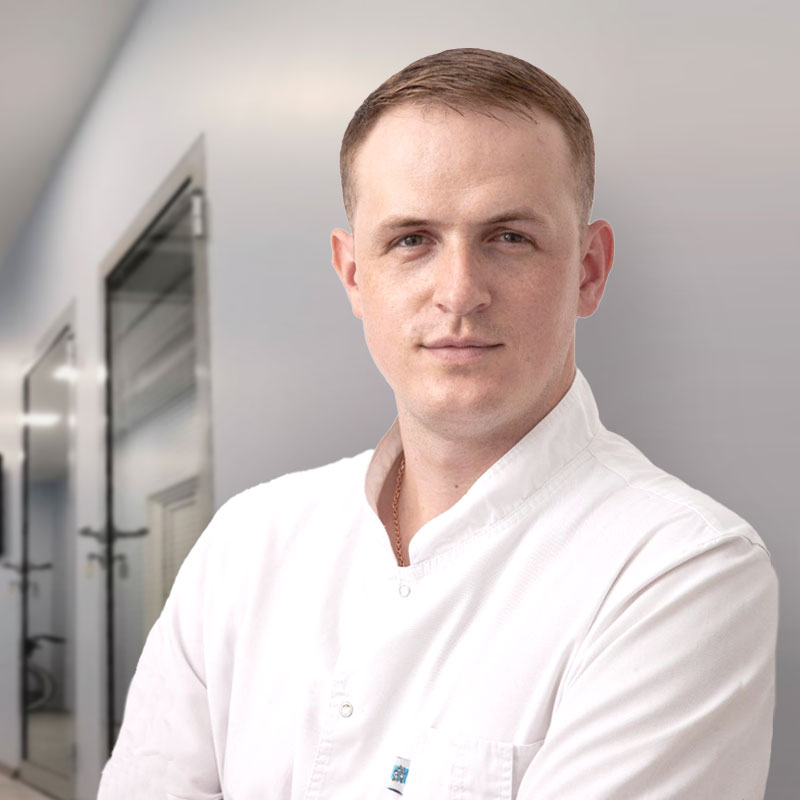
— Ivan Kurach, Endodontist, iDent
When Is Canal Retreatment Needed
If a tooth treated years ago starts hurting again, or an X-ray reveals a shadow near the root tip, infection has likely returned. In these cases the old filling material is removed and the canals are cleaned under the microscope to find and eliminate the source of the problem.
What Happens After Treatment
A devitalised tooth is more brittle, so after endodontic treatment we usually recommend protecting it with a crown. For teeth with significant structural loss we use a fiberglass post (UAH 900) and a post-and-core build-up. A properly restored tooth can last for decades.